Telescope Structure

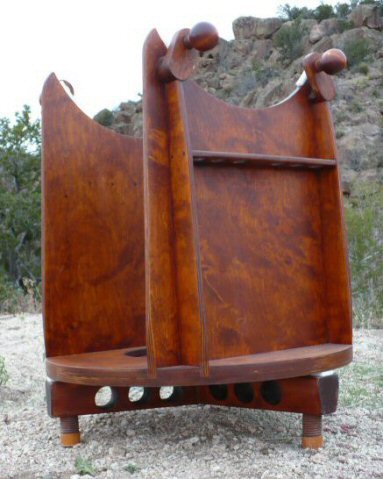
Wooden telescope clamp tube and base.JPG
COMPONENTS
A good telescope needs to have both good optics and a good mounting system. One without the other is useless. Since every little bump or wobble or vibration the mount allows is magnified by the optics into useless wildly dancing stars it is especially important to have a steady smooth mount like the one we provide.

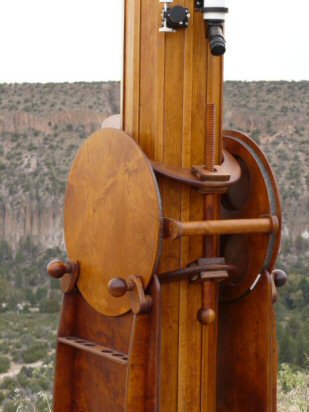
As you can see there are three main components to this telescope: The base which rotates horizontally in a circle, the Compton Clamp Assembly which holds the telescope tube and allows up and down movement, and the Dodecatube  itself which holds the optics.
Wooden telescope view along top of tube

THE  DODECATUBE


  • Our twelve sided Dodecatube™ is as functional as it is beautiful
  • First and foremost it firmly holds the optics in perfect alignment.
  • It is easily adjusted to provide balance and proper positioning of the eyepiece.
  • It blocks extraneous light and air currents from entering the optical path and degrading the final image.
  • It serves as a mounting point for the eyepiece focuser.
  • It holds accessories such as finder scopes and Lasar pointers.
  • It serves as a well leveraged handle to be gently pushed and pulled to point the scope at its intended target.
  • It is large enough to allow air currents to smoothly flow around the mirror mount letting it quickly cool to ambient temperatures avoiding the need for accessory cooling fans.
  • It is made of a material that will not absorb and release heat waves into the optical path.
"
TUBE STRUCTURE

The wooden baltic birch slats and ribs are configured in such a reinforcing way as to create a very stiff and lightweight tube. The solid structure blocks out image degrading stray light and prevents pesky image degrading wind currents in the optical path better than any substitute.

The self reinforcing rib structure eliminates the need for turbulence causing interior reinforcments and provides a nice handling exterior surface for pushing it into viewing position

It’s large diameter (nearly 11 inches) relative to mirror size allows for a smoothly flowing interior air flow. This prevents distortion causing turbulence and allows the mirror to cool off to ambient temperature quickly, avoiding the distortions caused by heat waves..eliminating theneed for internal fans and the power needed to run them.

Finally it’s made of wood which  is not only attractive but functional in preventing heat buildup
wooden telescope vertical closeup base.JPG
Wooden telescope tube clamp top view.JPG
COMPTON CLAMP and CRADLE ASSEMBLY

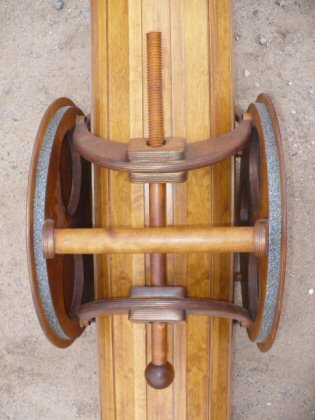
The twelve sided Dodecatube™ functions like a round tube in our patented clamp which allows you to easily slide the tube back and forth for perfect balance, and to rotate it to place the eyepiece for convenient viewing. The Compton Clamp™ loosens and securely locks down on the tube with a simple one hand adjustment of that large wooden screw on the top.
 
The sides of the mount do double duty as large circular altitude bearings which ride their laminate surfaces on pure Teflon pads. They are connected by three Maple connecting rods. The top rod has been enlarged to do double duty as a carrying handle, while the bottom two support the tube until tightening the lock gently lifts the tube to its suspended position.

The bottom of the cradle that holds the tube is 18 inches long which gives great leverage for positioning and great stability for holding the tube still. Force applied to the tube smoothly translates into up-and-down and back-and-forth movement. Wobble and backlash are minimized by the four adjustment knobs, so that the tube moves to where you aim it and stays there after you quit pushing.

This is important because every wobble or annoying backlash movement when you let go of the tube is magnified many times when looking through the scope.
ROTATING AZIMUTH BASE

The clamp and tube assembly rides on the base. This is a 24 inch diameter circle that rotates on three Formica-to-Teflon bearing pads on top of a flat, drilled-out tripod with adjustable peglegs for leveling purposes when setting the scope up on rough ground.
  
Two vertical boards rise up from the rotating base to form supports for the two huge altitude bearing circles on either side of the main telescope tube.

Most scopes connect these two risers with a reinforcing crossboard, but, for viewing convenience we allow the main tube to rotate all the way through the two vertical board ‘legs’. This means you can follow a star from horizon to horizon without doing the ‘Dobson Dance” halfway through. The Dobson Dance involves rotating the entire mount 180 degrees and reacquiring your target as it passes through the vertical tube position.

Instead, our scope is reinforced on the outside of the tube swing path with long narrow buttresses connected by an integrated eyepiece holder. Each riser is therefore held straight and stiff by a two inch thick rectangle made of the baseboard, the eyepiece holder, and the two arched buttresses.

At the top of the four high points where the support buttresses meet the riser boards are the spherical LipLocks™ that are used for fine tuning the tension and track made by the Formica rimmed altitude bearings floating on the large Teflon pads.

The 24 inch diameter base plate is almost 1 1/4 inch thick and had some 22 plies. The side fin/buttresses are 1/2 inch thick and have nine plies.
wooden telescope base closeup
M45 starfield
SIZE AND POWER

Size does matter. In general the larger the main mirror the better, because what you want is light gathering ability which increases as the square of the radius of the lens. That means a lens with twice the radius will collect  four times as much light.

The amount of useful power is also related to the diameter of the mirror. Any scope that advertises large power numbers is misleading you because any scope can have any power but useful power is limited by the size of the lens according to the laws of physics. Useful power figures out to be about 40x to 50x the diameter of the main lens or mirror in inches. In fact most useful viewing will be done at about half that power where a the wider field of view gives you one of those “oh my’ looks at  the night sky.

The focal length of the mirror we use is  a good compromise. ‘Fast’ lenses shorten the necessary tube length but introduce ‘coma’ and other optical impediments to good viewing which can only be overcome by using expensive, complex eyepieces and by using special alignment tools to adjust the optical elements. Slower or longer focus lenses require longer, more unwieldy tubes. Our 8” diameter f/6 mirror results in a very manageable 11” diameter tube only 4 1/2 feet long that you can easily push or pull with one finger to point anywhere in the sky.

The larger the lens the larger the slice of earth's atmosphere the telescope has to look through to see outer space. Large telescopes that gather more light must do so at the cost of having to look through more atmosperic distortions.
Because of the wavelength of light and the size of distortions there is a breaking point at about eight inches in diameter above which a telescope will be increasingly more affected by poor seeing conditions. In other words a scope lens over eight inches in diameter catches and magnifies air currents to a more noticeable degree. They do collect more light, and give incredible views, but you’ll get many more ‘good seeing’ nights out of our scope.

The human size of this scope means that you will get out looking more often because it's so much easier to handle.


Standard Dobsonian
Standard Dobsonian
DOBSONIAN DESIGN MODIFICATIONS

We replaced the side of the Tube support box with our huge altitude bearings. The bottom of the box becomes two maple support rods and the top becomes our Maple handle while our patented Compton Clamp™  holds the tube.

We incorporated the Rocker box sides with the cradle boards. Then we eliminated the front board in favor of our outlying buttresses tied together with the eyepiece holder to support and stiffen the sides.

Finally we made the ground board round and placed it on a low level tripod with leveling screws

Wooden telescope from below.JPG
HomeEasy to UseQuality
Hand CraftedWhy wood?
SpecsPrices \ Ordering